
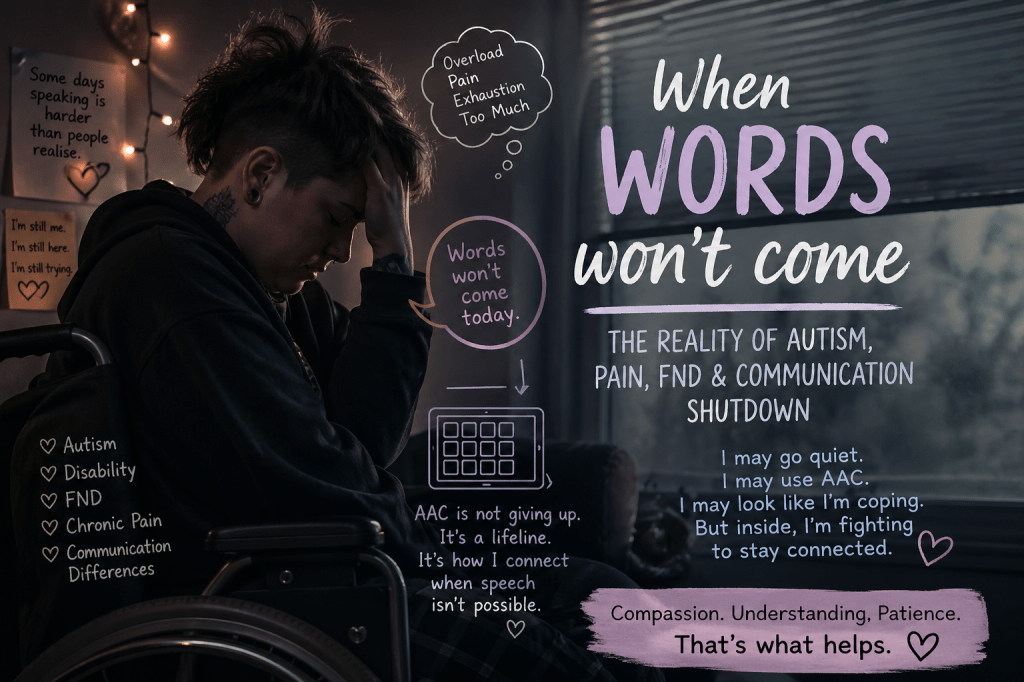
Some days I can write clearly, speak well, make jokes, explain myself, and look like I’m coping.
Some days I can come across articulate enough that people assume life must be manageable for me now. That I’m doing better. That I’m functioning.
Then there are days like today.
Today I feel exhausted in a way sleep hasn’t been able to fix. My body aches in that deep, heavy way that makes everything feel 1000x harder than it should. It feels like someone filled my limbs with cement overnight and expected me to carry on as normal when I woke up.
Pushing my wheelchair feels like hard work.
Every movement costs something.
Every sound feels sharper.
Every demand feels louder.
Every little thing feels like too much.
This is one of the hardest parts of living with autism alongside physical disability and Functional Neurological Disorder. People often separate things into boxes, but real life doesn’t work like that. Pain affects communication. Exhaustion affects sensory tolerance. Stress affects movement. Overload affects speech. Everything spills into everything else.
When my body becomes overwhelmed, my ability to communicate often starts to go with it.
That part is difficult to explain to people who only understand speech as something you either have or don’t have.
Sometimes I can speak, but it feels like dragging every word through mud.
Sometimes I know exactly what I want to say but cannot get it out.
Sometimes the effort it takes to answer a simple question feels enormous.
Sometimes I can physically speak, but doing so costs me so much energy that it pushes me closer to shutdown.
Sometimes words just stop.
Not because I’m being rude.
Not because I’m ignoring anyone.
Not because I’ve “gone in a mood.”
Because my system has hit capacity.
There is a specific kind of panic that comes when you know who you are, know what you want to say, know you are still fully there… but cannot access speech in the way people expect from you.
You are trapped inside yourself while everyone around you judges the silence.
That is a loneliness I struggle to describe.
I often force myself to keep talking because I’m scared of being misunderstood. I’m scared people will think I’m difficult, manipulative, dramatic or attention-seeking. I’m scared they’ll assume I’m choosing it.
So I mask.
I push.
I squeeze words out of a system already overwhelmed.
I perform being okay.
Usually in doing that it only makes everything worse. The more I force normality, the more my body fights back.
That cycle can become brutal.
Pain rises. Sensory overwhelm builds. Speech gets harder. Anxiety increases. I force speech anyway. Burnout deepens. Shutdown gets closer.
Then eventually I crash.
That is where AAC becomes important.
AAC stands for Augmentative and Alternative Communication. For me, it can mean using an app or device when speech becomes too difficult or inaccessible.
I wish more people understood that AAC is not failure.
It is not “giving up talking.”
It is not dramatic.
It is not attention seeking.
It is accessibility.
It is support.
It is dignity.
It is me finding another route when the main road is blocked.
But even with that, there is fear.
Many people only accept support needs when they look permanent and obvious. If you can speak on Monday, they struggle to understand why you need AAC on Tuesday. If you managed conversation last week, they question why you are quiet now.
People are often comfortable with disability when it is predictable.
Mine often isn’t.
That unpredictability exists with FND too. Symptoms can flare when my nervous system is overloaded. Fatigue increases. Pain increases. My body feels less reliable. My energy disappears faster. The things I could manage yesterday can suddenly feel impossible today.
That inconsistency can make people suspicious.
But inconsistency is often the reality of disability.
I think one of the rawest truths is this: sometimes I spend more energy trying to look okay than I do actually coping.
I can appear calm while internally screaming.
I can answer politely while mentally drowning.
I can smile while nearing shutdown.
I can sound eloquent while missing half of what is being said.
That is the danger of masking. People praise how well you seem while completely missing how much it is costing you.
Today my mood is low, but not because I’ve “given up” or because I’m in crisis.
It is because pain is draining.
Because communication is harder.
Because everything takes effort.
Because living inside a body and nervous system that keep changing the rules is exhausting.
Because there is grief in repeatedly needing help for things other people never have to think about.
There is grief in wanting to speak freely and struggling.
There is grief in being misunderstood.
There is grief in having needs that people doubt because they cannot see them.
But there is also truth.
The truth is I am still me when words won’t come.
I am still intelligent when speech is hard.
I am still trying when I go quiet.
I am still present when I need AAC.
I am still worthy when I need support.
Today, instead of pushing myself until I completely break, I am trying to listen earlier.
That may not look impressive from the outside.
But sometimes healing is not dramatic progress.
Sometimes healing is recognising the warning signs sooner.
Sometimes healing is using the support you need before you collapse.
Sometimes healing is choosing compassion for yourself when the world keeps demanding performance.
If you know someone who goes quiet, struggles to communicate some days, uses AAC, cancels plans, or functions inconsistently because of disability, please try not to assume the worst.
Sometimes silence is not rejection.
Sometimes quiet is not attitude.
Sometimes inconsistency is not laziness.
Sometimes it is survival.
Sometimes the bravest thing a person can do is stop pretending they are fine.
Living out loud. Healing out loud. So others feel less alone.

 Jordan Beaven
Leave a comment